
Annual rate of house price growth drops as mortgage approvals fall
Nationwide and Halifax have both published their house price index for December 2022, revealing a sharp fall in annual house price growth at the end of the year.
Nationwide report a fourth consecutive monthly decline, with a fall of -0.1% in December resulting in an annual house price growth of 2.8%.
House price growth slowed in all UK regions, which experienced steep falls in the last quarter of the year.
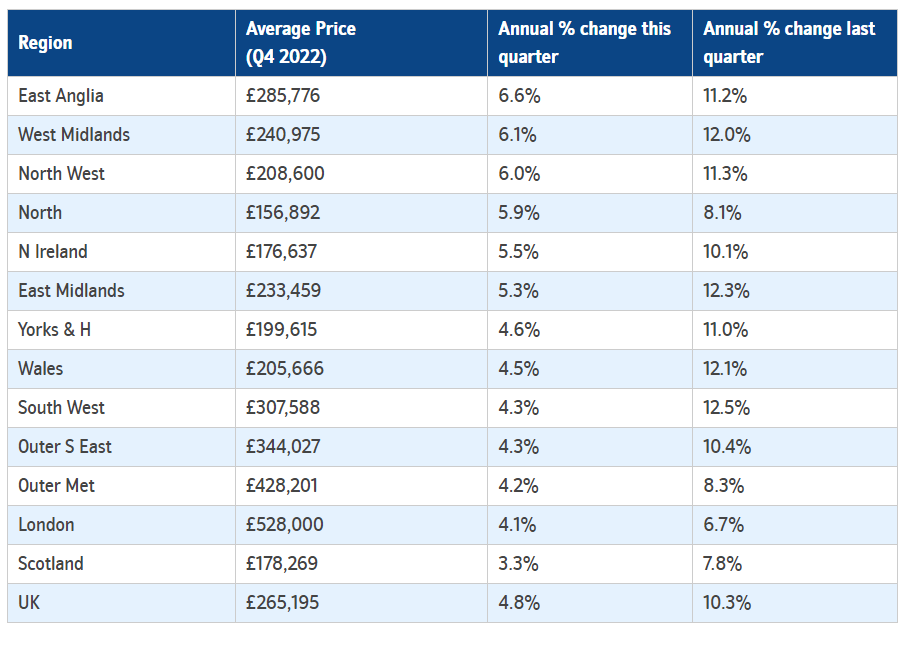
The mortgage lender also revealed that, since the first quarter of 2020, price growth in detached properties was around double that of flats, as the pandemic drove buyers to seek more space.
While financial market conditions have settled, mortgage rates are taking longer to normalise and activity in the housing market has shown few signs of recovery.
robert gardner, chief economist, nationwide
It will be hard for the market to regain much momentum in the near term as economic headwinds strengthen, with real earnings set to fall further and the labour market widely projected to weaken as the economy shrinks.
Meanwhile, Halifax reported a -1.5% fall in house prices in December, with the annual rate of growth dropping to 2.0% from 4.6% in November.
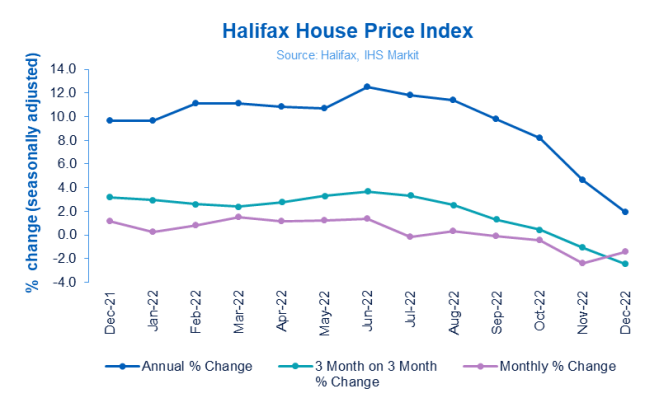
The Halifax House Price Index was established in January 1983. In 40 years of reporting, the index has seen the average UK house price go from £26,188 to £281,272 – a growth of 974%.
As we enter 2023, the housing market will continue to be impacted by the wider economic environment and, as buyers and sellers remain cautious, we expect there will be a reduction in both supply and demand overall, with house prices forecast to fall around 8% over the course of the year.
kim kinnaird, director, halifax mortgages
Mortgage approvals have fallen by 33% in November compared to the same month in 2021, according to the Bank of England.
With 46,075 mortgages approved in the month, the figures represent the lowest level since the height of the Covid pandemic in June 2020, and show the impact of the catastrophic ‘mini-budget’, which saw mortgage interest rates rocket to an average of above 6% for some deals.
Construction firms brace for challenging year as fresh wave of price hikes hit
Financial experts Red Flag Alert have warned that more than 100 building firms could become insolvent each week in 2023, as the total number of insolvencies across all sectors is set to hit 32,000 this year.
As reported by the Construction Enquirer, Red Flag Alert estimate there is around £300m in bad debt within the UK construction industry, which could increase to £1bn by the start of next year.
Meanwhile, contractors continue to face further cost inflation, despite a fall in raw material and energy costs.
Plasterboard is due to increase by up to 17% from January, with insulation materials set to rise by 10%.
Noble Francis, Economics Director at the Construction Products Association, suggests that expired fixed energy contracts are driving the increase in material costs.
He said: “Many manufacturers are on fixed forward contracts for energy so the full impact of the initial energy price rises is phased over time, so some manufacturers were coming off energy contracts signed a couple of years ago in Autumn, which meant a sharp rise in energy costs even though energy spot prices fell in Autumn.”
Housebuilding activity has fallen at the fastest rate since May 2020, according to the latest Construction Purchasing Managers’ Index (PMI) from S&P Global / CIPS UK.
The index fell to 48.8 in December, down from 50.4 in November, and marks the end of a three-month period of growth.
Any figure below 50 indicates a contraction in output. This was the first reading below this level since August 2022.
Site management scheme for women launched
The Home Builders Federation (HBF) and Women Into Construction (WIC) have launched a nationwide employment programme designed to attract more women into site management roles.
The project sees HBF and WIC work with Barratts, Bellway, Cala, The Hill Group, Keepmoat, Persimmon, Redrow, St. Modwen and Vistry, and seeks to address the gender imbalance in the construction workforce, which currently sees just 16% female representation.
The unique programme will provide support with childcare and training costs, and feature development sessions, site visits and a two-week work placement on site.
With women representing just 4% of Site Managers, we want to inspire and encourage more women to take up a career in home building – helping us and our employer partners to change the face of construction.
jacqui wordsworth, business development director, women into construction
The home building industry is facing a significant skills shortage. If we are to build the new housing this country desperately needs, it is vital that we attract a broad range of entrants into the industry.
jenny herdman, director, hbf home building skills partnership
Gove calls for better housing design amidst revised NPPF consultation
Michael Gove has called for developers to focus on the “heart and soul” of areas they wish to build in, to curb opposition to new housing developments.
Commenting in the foreword to A School of Place, a report by think tank Policy Exchange, the Levelling Up, Housing and Communities Secretary said that too many planning applications were “indifferent” or “insipid”.
It is important too to not only protect our heritage and improve our shared urban landscape, but also to held address the housing crisis.
michael gove mp
Much of the opposition to new housing developments is often grounded in a fear that the quality of the new buildings and places created will be deficient and therefore detrimental to existing neighbourhoods and properties.
Meanwhile, the Government has published its long-awaited consultation on its revisions to the National Planning Policy Framework (NPPF).
Releasing the consultation on 22 December 2022, which closes on 2 March 2023, the Department for Levelling Up, Housing and Communities (DLUHC) sets out their objectives, including building “beautiful and refusing ugliness”, securing the infrastructure needed to support development, more democratic engagement with communities on local plans, and empowering communities to shape their neighbourhoods.
The revised NPPF is anticipated to be published in the spring.
 Housing View