
ANNA CLARKE

ANNA CLARKE IS DIRECTOR OF POLICY AND PUBLIC AFFAIRS AT THE HOUSING FORUM.
Opposition to new housing is often galvanised around claims that the proposed new homes are ‘executive homes’ – homes that are not affordable to ‘local people’ so therefore unhelpful. But what do we mean by an ‘executive home’, and who buys them if they’re not affordable?
It’s worth noting that a lot of the time ‘executive homes’ is just a marketing phrase used by developers who want to gain the best price. Clearly there are buyers out there who like the idea of living in an ‘Executive Home’ themselves.
But if you look on Rightmove, it’s possible to find very ordinary-looking two bedroom bungalows selling for less than £200,000 and marketed as ‘Executive’: sometimes, it just seems to mean ‘new’.
Why would we build for this group of wealthy people, rather than the first-time buyers struggling to get a foot on the housing ladder?
But some of these homes certainly are high value – four and five bedroom new-build homes in the south of England commonly sell for upwards of £1m. Are these unaffordable? Well, obviously not in the true sense, because the price of anything is what someone will pay for it. These homes are being sold to people who are just as real as any other people.
It is true, of course, that anyone in the market for that kind of home is unlikely to be in any kind of housing need right now – they may not need a newer, nicer or bigger home.
Why would we build for this group of wealthy people, rather than the first-time buyers struggling to get a foot on the housing ladder? The answer is that the wealthy family purchasing the £1m house are generally only able to do so by selling their existing home.
Maybe that’s a 3 bedroom semi, which they sell for £700k. This will probably not be bought by a first-time buyer either, but by another family upsizing – extending a mortgage or using some cash they’ve saved or inherited to move up in the housing market. Every mover in the chain has a home to sell – and at the end of the chain there’s usually a first-time buyer; a household getting their first home – moving out from their parents, or out of rented housing, into a home of their own.
Maybe people should reflect a bit more about how the housing system operates before objecting to ‘executive homes’
Academics use the rather odd term of ‘filtering’ to describe this process. ‘Chain moves’ is probably a better phrase, and more easily understood. The same process applies in social housing, where the larger houses aren’t just a luxury but really badly needed to address overcrowding.
Does it really matter if the first-time buyer buys a new-build house, or the one at the end of the chain? It’s a little bit easier for developers to sell to first-time buyers; they can usually be flexible about when they move.
However, there’s also what’s known as the ‘new-build premium’ – new houses sell for a bit more than the equivalent sized second-hand house. This shouldn’t really surprise us – we know that new cars (or anything else) sell for more than older ones.
People will pay a bit more for shiny new homes, where they can choose the décor and maybe the kitchen layout, and move into a pristine new home. But this means they’re less well suited to first-time-buyers or anyone at the margins of affordability. Much better to let wealthier households purchase new homes, and let the first time buyers start out in a scruffier old home, that’s more easily affordable.
This isn’t just theory – we know from data from the English Housing Survey that just over half of owner-occupiers who’ve moved recently moved from another owner-occupied home. A third moved into owner-occupation from private renting, and most of the rest were newly forming households – mostly moving out from their parents.
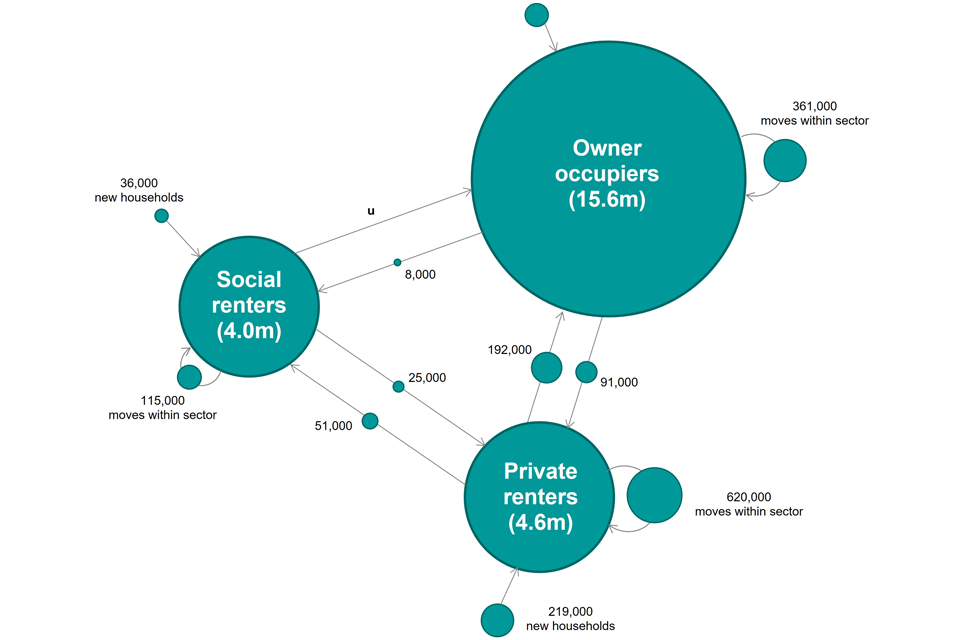
But what about landlords? Do they disrupt these chains of homebuyers? We know that around 10% of homes are bought by landlords, and they often compete with first-time buyers for the cheaper properties, and for flats.
Does it matter if the landlords buy the newbuild homes or the cheaper ones further down the chain? Not really. Either way there’s an extra home coming into use. So maybe people should reflect a bit more about how the housing system operates before objecting to ‘executive homes’.
For families with 4 or more children, or multi-generational households, 4 or 5 bedrooms may be badly needed to meet their requirements. But – for average-sized families – these bring space for siblings to have their own rooms, a home office, a guest room…things that improve our lives; and, by building the larger homes, we can trigger a cascade of people trading up into larger homes, and at the end of the chain either a first-time buyer or a renter moving out into a home of their own for the first time.
 Housing View