
Official figures show third successive year-on-year house price rise
The Office for National Statistics has published its house price index for June 2023, revealing a slight slowing in annual house price inflation to 1.7% (May: 1.8%).
The rate of annual house price growth was the slowest since July 2020. However, annual house prices increased for the third consecutive month, reaching a value of £287,546 in June.
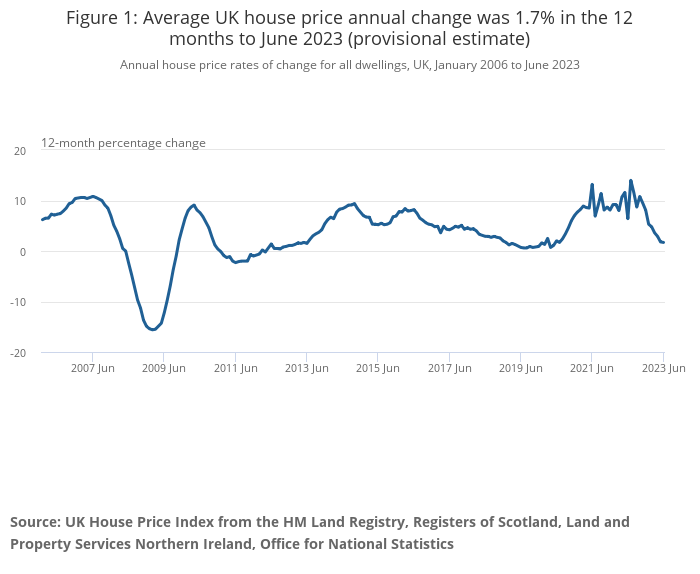
Average house prices increased at the greatest rate in Northern Ireland, where values reached £174,000 (2.7%). Next was England, at £306,000 (1.9%) and Wales at £213,000 (0.6%), with growth in Scotland remaining flat at £189,000 (0.0%).

Meanwhile, in England, the North-East enjoyed the highest rate of annual growth, reaching 4.7%, with London propping up the table at -0.6%.

Value of construction starts down a third – but residential construction increases
Research consultant Glenigan has published its latest Construction Review, covering the three months to the end of July.
The report reveals a fall in the value of construction project starts across the UK by a third when compared to a year ago.
However, there were a few “glimmers of hope”, with residential construction increasing by 21% during the review period, although it remains 26% lower than a year ago.
Meanwhile, private housing starts increased by 40%; and, while the value of detailed planning approvals fell by -26% compared with the previous quarter, it was 37% higher than April to July 2022.
Changing government priorities in the run-up to the general election are also likely to slow investment in major infrastructure projects, halting activity further.
Allan Wilen, Economics Director, Glenigan
Despite this, residential construction offers a glimmer of hope, with increases in private housing starts helping to offset sluggish activity in this sector vertical.
Housing Forum writes to Gove over second staircase proposal
The Housing Forum has written to Housing Secretary Michael Gove to voice concerns over the Government’s proposals for second staircases in tall residential buildings.
Earlier this year Michael Gove reduced the threshold for second staircases from 30m to 18m, after a consultation on the proposals in December.
But The Housing Forum has written an open letter to Gove, stating that – even with the reduced height limit – “a large number of additional buildings at different stages of development are now falling within scope.”
Anna Clarke, Director of Policy and Public Affairs at The Housing Forum – who recently wrote a guest post for Housing View – also highlighted the lack of technical specifications.
The lack of technical specifications means that those designing or constructing tall buildings are don’t have clear instruction on exactly what they need to do.
Anna Clarke, Director of Policy and Public Affairs, The Housing FOrum
They are also unable to make sensible evidence-based decisions on risk for themselves, because they are not clear on the core purpose of the two staircases.
We’re particularly concerned about the delivery of Affordable Housing with many of our social landlord members unable to identify the finance the costs or redesign or compensate for the loss of floor space required to fit the second staircase in.
You can read the full letter here.
Cala reveals fall in profit and sales
Parent company Legal & General (L&G) revealed this week that Cala Homes has experienced a drop in pre-tax profit in the six months to 30 June 2023.
The developer also sold fewer units, achieving 1,428 sales against 1,527 in the same period last year, generating £73m of profit (H1 2022: £98m).
L&G stated that the housebuilder had “continued to perform well over H1 2023 in the face of a challenging market”, and that Cala were on track to deliver their full-year targets.
Meanwhile, building products firm Marshalls has reported a fall in profit, just weeks after announcing job cuts.
The firm’s half-year results for 2023 revealed that pre-tax profit was £16.7m, down by 30% when compared to the same period last year.
Marshalls has forecast challenging trading conditions to continue into 2024, with Chief Executive Martyn Coffey stating: “we have been careful to ensure that we have sufficient latent manufacturing capacity that will allow us to respond quickly when there is an improvement in market conditions.”
 Housing View