
Government plan to unblock thousands of homes defeated at House of Lords
Plans to scrap nutrient neutrality rules and unblock around 150,000 new homes have been blocked by the House of Lords, prompting fury within the housing sector.
A coalition of Conservatives, Labour and other parties defeated the proposal this week, with new Shadow Housing Secretary Angela Rayner stating: “The Conservatives are being thoroughly disingenuous in suggesting that the only way we can build the homes we need in river catchment areas is by weakening environmental law. No one should fall for it.”
The Home Builders Federation (HBF) reacted first, stating that the move would:
…do nothing to improve the shocking state of our rivers, polluted by agricultural run-off and the failings of water companies, but will exacerbate our housing crisis still further.
With growing waiting lists, a generation unable to buy, local economies damaged, and jobs lost, the mishandling of this issue is a national disgrace.
A damning indictment that after four years politicians have completely failed to find a solution.
Stewart Baseley, Executive Chairman, HBF
Lawrence Turner, Director of planning consultant Boyer, stated in Housebuilder magazine: “The rejection of the Bill translates into further stagnation of construction for over 100,000 homes. Most of these homes have already received planning consent and are supported by local communities, adding to the gravitas of the delay.”
Other industry figures also voiced their frustration.
While nutrient pollution in this country is a serious problem, new homes are not the cause of it – they are only responsible for around five per cent.
Bartek Stainszewski, Senior REsearcher, Bright Blue
HBF lashes out at councils and water companies
The Home Builders Federation (HBF) has accused local authorities of failing to spend millions of pounds in Section 106 contributions, with an estimated £2.8bn ringfenced for local services and infrastructure upgrades sitting in bank accounts.
Section 106 contributions are often made by housing developers to local authorities as part of the planning process; but a new report by the HBF claims that much of it is going unspent.
The unspent funds include:
- £567m for affordable housing
- £420m for schools
- £384m for highways improvements
- £334m for social infrastructure contributions
The report, collated using responses from 171 local authorities, found that an average of £8m is being held by each council. Extrapolated across all local councils, the total estimate for unspent contributions reaches £2.8bn.
Meanwhile, Britain’s biggest local authority, Birmingham, declared bankruptcy earlier this month. It is predicted that up to 26 more councils could go bust in the next two years.
Not only is this a disservice to communities but it undermines perceptions of home building, allowing lazy negative perceptions to persist.
Stewart Baseley, Executive Chairman, HBF
In the face of a deepening housing shortage and cost of living crisis, it has never been more important to build new homes and local people should enjoy the benefits that can bring.
The HBF has also reported that more than £1bn has been given to water companies by housing developers in the past three years, who have failed to deliver adequate infrastructure to support new homes.
The news comes as the Office for Environmental Protection announces that Government and regulators have broken the law by not keeping sewage companies in check.
Meanwhile, figures from the Department for Environment, Food and Rural Affairs suggest that 60-80% of phosphorus entering rivers is down to a failure by water companies to effectively treat wastewater.
Vistry adopts partnerships-only strategy as Redrow sales fall
Developer Vistry has announced a change in strategy as the private market continues to decline, favouring a partnerships approach over the more traditional housebuilding model.
The decision will result in a restructure of the business, with 32 business units reducing to 27, and is forecast to deliver £25m in cost savings and £1bn to shareholders over three years.
The announcement came as the firm reported first-half pre-tax profits of £114m, with revenue up by a third at £1.57bn.
Meanwhile, Redrow have reported declining sales since the start of July, with a reservation rate of 0.34 per outlet per week; a sharp fall from 0.61 over the same period last year.
Reporting its results for the year ending 02 July 2023, the developer acknowledged a “challenging” summer but claimed a “strong underlying performance in an uncertain market”.
Revenue for the firm totalled £2.13bn (2022: £2.14bn), with pre-tax profit of £395m (2022: £246m).
Housebuilding activity to fall by a fifth in 2023
Analysis by cost consultant PwC has forecast that residential activity will decline by -21% in 2023, with higher mortgage rates weakening demand.
The firm’s Construction and Housebuilding Outlook also predicts a -5% decline in overall construction over the same period.
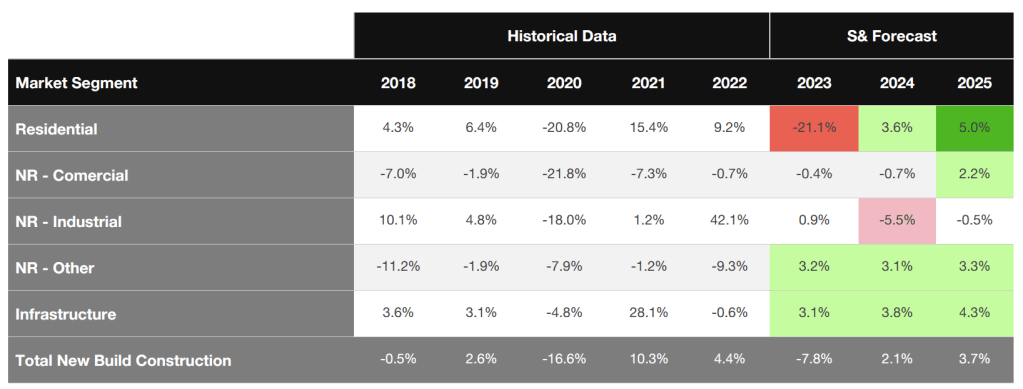
Housebuilders will continue to be selective on new site starts, the report states, with a greater focus on partnerships with affordable housing and private rental providers.
With a sharp fall in demand, house-builders will logically act to preserve cash and ensure they are building only what they could sell.
Paul Sloman, Engineering and Construction Sector Leader, PwC
However, despite these headwinds, we do see green shoots and predict an overall return to strong growth in 2024 and 2025.
 Housing View