
Various bodies make recommendations to fix planning perception and process
Several reports have been published over the past couple of weeks which seek to address the ongoing issues faced by developers as a result of a struggling planning system.
Social enterprise Public Practice have revealed that almost 80% of local authority planning teams struggle to attract qualified and skilled candidates, in their Recruitment and Skills Report, commissioned by the Department for Levelling Up, Housing and Communities.
The report also found that 66% of local Government professionals believe their team lacks the skills to cope with their top priorities, with a lack of capacity in planning teams leading to poor morale and low job satisfaction. Just over half of survey respondents said that they have trouble retaining staff.

Meanwhile, a report into the English planning system by the Building the Future Commission has found an increase in waiting times, a decrease in performance, and cash-strapped local authorities struggling to function.
The review proposes some recommendations to make the planning system fit for purpose, including:
- Properly resourcing the planning system;
- Ensuring local plans are put in place;
- Reinstating a strategic planning tier;
- Simplifying the system of planning contributions.
Finally, the All-Party Parliamentary Group for Housing Market and Housing Delivery has published Hacking Housing: Nine Supply Side Hacks to Fix our Housing System Error, with calls to make planning “sexy”, alongside the return of the Chief Planner, describing the role as “a pretty cool job”.
Housing is the longest, hardest, most expensive, most complicated, most politically contentious element of any government policy.
Ben Everitt MP, CHair of the APPG for Housing Market & Housing Delivery
And it’s fundamental to almost all policy areas. It’s underrated. It’s unloved. It’s time for housing and planning to glow up.
The report also confirms that the Government’s target of 300,000 homes a year “remains elusive, despite post-pandemic progress”, and “will not be achieved without a dramatic overhaul of the market, policy and notably, the politics of housing”.

Meanwhile, a report by the Home Builders Federation (HBF) has stated that homes in England are less affordable and in a worse condition than those in most other developed nations.
In a paper called Housing Horizons, the HBF also revealed that England has the lowest rate of available properties per member of the population of all Organisation for Economic Co-operation and Development nations.
England also has the highest proportion of inadequate housing in Europe, and only 7% of British homes were built after 2001.
The country is in dire need of more high quality and energy efficient new homes.
Stewart Baseley, Executive Chairman, Home Builders Federation
With an election looming and manifestos being considered, today’s research should act as a wake-up call, demonstrating the urgent need to act now to prevent us falling even further behind.
Annual house prices fall across all regions in Q3
Analysis by Nationwide has found that house prices remained unchanged in September, but remained -5.3% lower over the year.
Recording the average property value at £257,808, the mortgage lender also revealed that house prices fell across all regions in Q3 when compared to the same period in 2022.

The South West was the weakest performing region, with prices down by -6.3% across the year. Northern Ireland experienced the best performance, with a modest -1.8% fall.
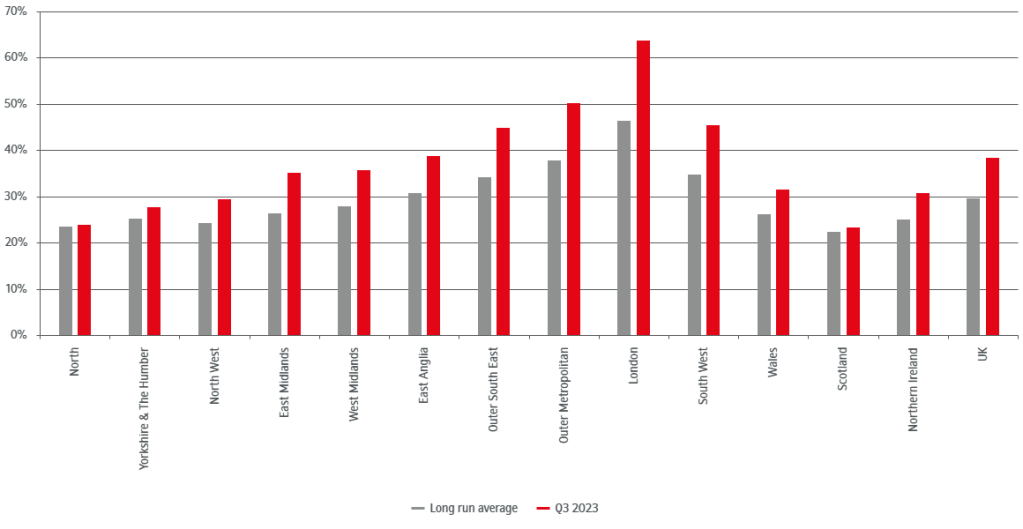
Despite the fall in average prices, home ownership continues to remain unaffordable, with the typical first-time buyer with a 20% deposit spending 38% of their take home pay on their monthly mortgage payment – well above the long-run average of 29%.
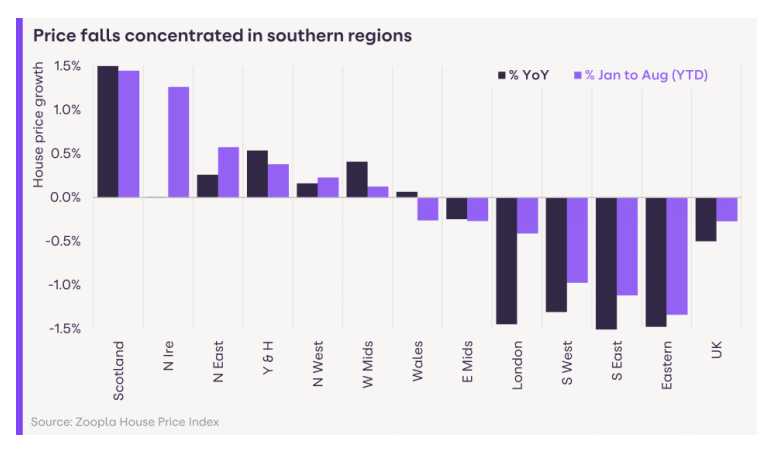
Meanwhile, Zoopla have recorded annual house prices moving to -0.5% in September, with demand rebounding as market sentiment improves.
The property website also predicted a slow fall in mortgage rates in Q4 2023, whilst asking prices are discounted by -4.2% on average; the highest since 2019.
Meanwhile, house price falls are on track to be -3% lower by the end of 2023 than at the same time in 2022.
The latest Halifax house price index has found that the average property value fell by -0.4% in September, but that the pace of monthly decline is slowing, with August recording a monthly price fall of -1.8%.
However, property prices fell by -4.7% on an annual basis, compared to -4.5% last month.
Activity levels continue to look subdued compared to recent years, with industry data showing lower levels of new instructions to sell homes and agreed sales. Borrowing costs are the primary factor, given the impact of higher interest rates on mortgage affordability.
Kim Kinnaird, Director, Halifax MOrtgages
Against this backdrop, homeowners inevitably become more realistic about their target selling price, reflecting what has increasingly become a buyer’s market.
Gove reiterated homes target, as biodiversity net gain regulations delayed
Levelling Up Secretary Michael Gove has confirmed that the Government is on course to reach its target of one million new homes during its Parliamentary term.
Speaking at the Conservative party conference in Manchester, Gove said: “We are on track to deliver a million new homes in this parliament. But we need many more. And our long-term plan for housing will deliver the attractive, affordable new homes that we need.”
Gove also confirmed plans to introduce a nutrients reform bill at “the first available opportunity”, following a recent defeat of proposals to unlock thousands of new homes by the House of Lords.
Meanwhile, biodiversity net gain (BNG) regulations have been delayed until January 2024, following an updated timetable by the Department for Environment, Food and Rural Affairs (DEFRA).
Originally slated for November 2023, the rules would mandate a minimum of 10% BNG within new developments in England.
However, DEFRA will now publish guidance, regulations and calculation metrics for BNG by the end of November.
Home builders across England and Wales have embraced the principle of biodiversity net gain and are committed to creating places that protect and enhance the natural environment.
We urge the government to use the time to ensure the required guidance is in place such that housebuilders can deliver the benefits of BNG alongside desperately new homes.
Home Builders Federation
Meanwhile, the Liberal Democrats have kept their commitment to a 380,000 homes-a-year target following a rebellion at the party’s conference in Bournemouth.
The party had proposed replacing the target with building 150,000 social homes a year, but the Young Liberals group argued that the original target needed to remain, despite former leader Tim Farron arguing that a 380,000 homes-a-year target was “vague”.
Chartered Institute of Housing publishes manifesto
The Chartered Institute of Housing (CIH) has called upon all political parties to “commit to a long-term plan for housing which recognises it as the foundation for creating healthy and sustainable communities”.
In a ten-point plan published last week, the CIH sets out recommendations for building more homes, and better homes, including:
- Investing in more social homes;
- Improving the planning process;
- Improving security and standards for private renters;
- Prioritising building safety.
More detail is set out in the CIH’s strategy for housing.
Housebuilding drags down construction output
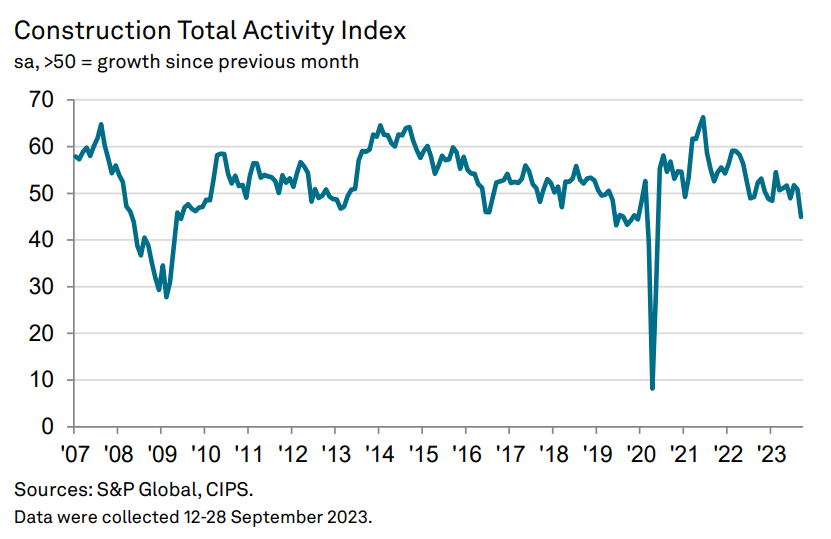
The latest S&P Global / COPS UK Construction Purchasing Managers’ Index has reported the first downturn in construction output in three months, led by a steep fall in housebuilding.
The overall index registered 45.0 in September (Aug: 50.8). Any reading below 50.0 represents a decline in output.
Residential work was by far the worst-performing sector, registering 38.1 on the scale.
 Housing View