
DLUHC paper seeks to unlock regeneration
This week saw the Department for Levelling Up, Housing and Communities (DLUHC) publish its consultation on strengthening planning policy for brownfield development.
The consultation seeks views on proposed changes, including amending planning policy to take a “flexible approach” and give significant weight to the benefits of delivering as many homes as possible, requiring local authorities to be “less bureaucratic and more flexible in applying policies that halt housebuilding on brownfield land”.
The Government is also proposing to extend permitted development rights, allowing commercial buildings of any size to be converted into new homes, unlocking “thousands of quality new homes by 2030”.
Today marks another important step forward in our Long-Term Plan for Housing, taking a brownfield first approach to deliver thousands of new homes where people want to live and work, without concreting over the countryside.
Michael Gove, Secretary of State for Levelling Up, Housing and COmmunities
Our new brownfield presumption will tackle under delivery in our key towns and cities – where new homes are most needed to support jobs and drive growth.
The proposals received a mixed response, with David Thomas, CEO of Barratt, stating: “We welcome any efforts to make it easier to get planning permission, particularly for brownfield regeneration which is already naturally a more complicated and capital-intensive process.”
Others were less enthusiastic.
There isn’t enough brownfield land to get close to solving the housing crisis and whilst this policy is welcomed as a concept, if it exists to avoid the political backlash from building on the green belt, we should expect the housing crisis to endure.
Richard Beresford, Chief Executive, National Federation of Builders
We welcome the Government’s proposals to encourage developers to build on urban brownfield land. Now we need a proper brownfield-first policy too. Without one we will continue to see a chronic lack of genuinely affordable housing or homes for social rent in rural areas.
Paul Miner, Head of Policy and Planning, CPRE
Gove also announced a £3bn increase in an affordable housing loan scheme, intended to build 20,000 new homes.
The expansion of the Government’s Affordable Homes Guarantee Scheme comes alongside a pledge by the Secretary of State to end no-fault evictions, stating that they will be banned before the next General Election.
In a busy week, DLUHC also said that it is working on a “managed transition” to a new building control regime amidst concerns that the current deadline of 06 April could result in a sudden stop in work.
Building control professionals are required to prove their competence and join the Building Safety Regulator’s register, or risk losing the ability to practice.
Average house prices fall to December
Official figures from the Office for National Statistics (ONS) have revealed that the average UK property price fell by -1.4% over the year to December 2023 to £285,000.
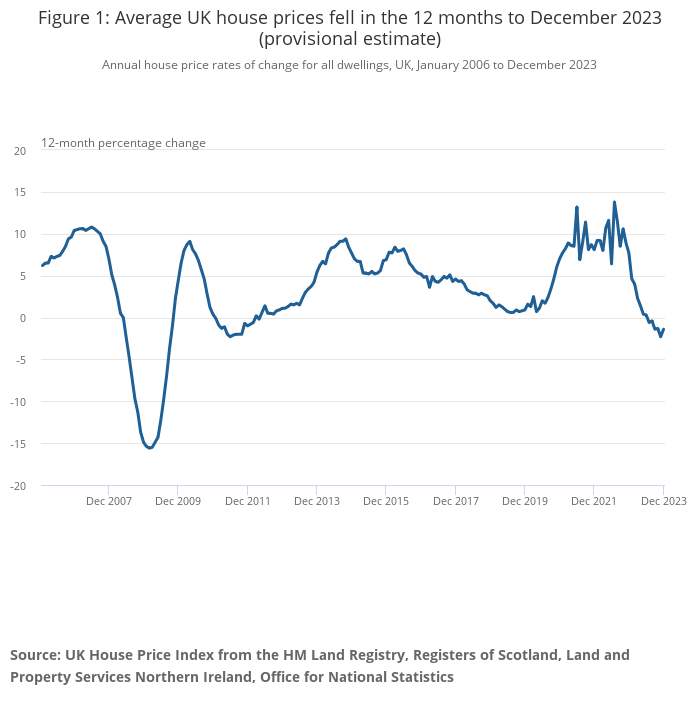
House prices in England fell by -2.1% over the same period, with Wales also experiencing a fall in house prices of -2.5%.
However, average house prices increased in Scotland by 3.3%.

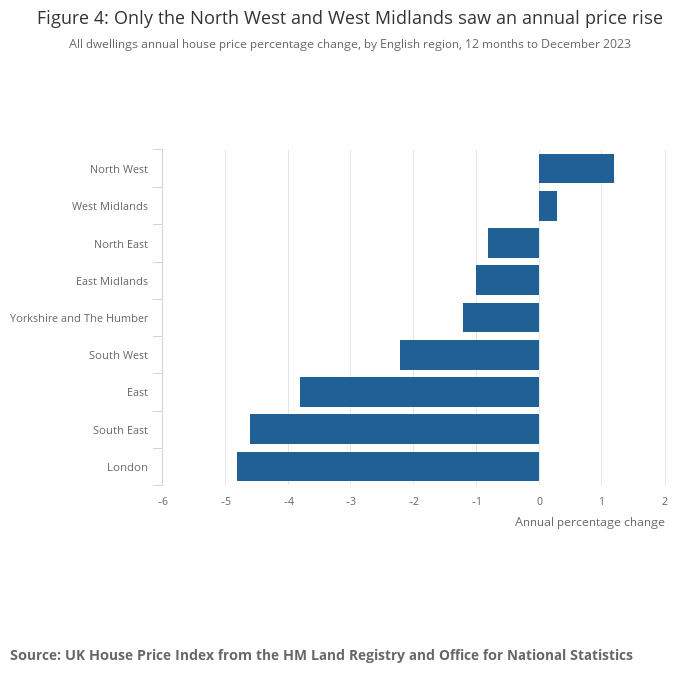
In England, only the North West and West Midlands regions saw an annual increase in house prices. London was the worst performing region, where prices fell over the year by -4.8%.
Meanwhile, ONS data also revealed that construction output decreased by -0.5% in volume terms in December 2023 – the third consecutive monthly fall – driven predominantly by a -1.1% fall in new work.

For the year as a whole, construction output is estimated to have increased by 2.0% when compared with 2022, making it the third consecutive year of annual growth.
 Housing View