
HBF review finds only 11 of 36 recommendations in place
The Home Builders Federation (HBF) has published an assessment setting out industry progress since Kate Barker’s Review of Housing Supply report in 2004.
The Review was commissioned by the Government to provide a comprehensive understanding of the issues underlying a lack of housing supply, and triggered a range of planning reforms and responses from the industry.
However, the HBF’s Beyond Barker report has found that England would have 2 million more homes today if the Barker Review’s most ambitious scenario for increasing housing supply had been achieved.
The report also found:
- This shortfall is equivalent to the entire housing stock of Ireland, or the number of homes in the urban areas of Manchester and Birmingham combined.
- Looking at Barker’s central housing supply scenario (requiring 240,000 homes to be built a year), England has still fallen 900,000 homes short of the total number needed to make the market more affordable over the past 20 years.
- Only 11 of the 36 recommendations of the Barker Review are currently in place – with a further 10 having only been partially implemented. 5 recommendations were implemented and then reversed.
- The recent changes to the National Planning Policy Framework (NPPF) undermined progress in implementing 3 of the Barker Review’s recommendations – those relating to targets, the allocation of land by local authorities, and the Green Belt.
- Most indicators of housing affordability have worsened over the past twenty years since the Review’s publication.
All indicators now show a further sharp decline in supply is ahead – the inevitable result of several years of anti-growth policy and rhetoric.
The politically driven weakening of the planning system will impact housing supply for years to come and needs to be urgently reversed, whilst many of the other recommendations put forward 20 years ago could still have a positive impact.
Stewart Baseley, Executive Chairman, Home Builders Federation
Monthly house prices fall as north / south divide prevails
Both Halifax and Nationwide published their house price indices for March this week, revealing a slight fall in property values during the month.
House prices dipped by -1.0% in March, according to the Halifax, with the average UK home now costing around £288,430. However, property prices grew by 0.3% over the year.

Northern Ireland remains the strongest performing nation or region in the UK, with house prices increasing by 4.3% annually. In Wales, annual growth was 1.9%, with Scotland reaching 2.1% growth.
Properties in the North West of England saw the strongest annual growth of 3.7%; but homes in Eastern England registered the largest annual decline, at -0.9%.
The housing market remains sensitive to the scale and pace of interest rate changes, and with only a modest improvement in affordability on the horizon, this will likely limit the scope for significant house price increases this year.
Kim Kinnaird, Director, Halifax Mortgages
Meanwhile, Nationwide registered annual growth at 0.7% in March, with the average property price edging down by -0.2% in the month to £261,142.
The mortgage lender also noted something of a north / south divide, remarking that prices increased by 1.7% over the year across northern England, but dropping by -0.3% in southern England.


With income growth continuing to outpace house price growth by a healthy margin, housing affordability is improving, albeit gradually.
If these trends are maintained, activity is likely to gain momentum, though the pace of the recovery is still likely to be heavily influenced by the trajectory of interest rates.
Robert Gardner, Chief Economist, Nationwide
Housing stable as construction returns to growth
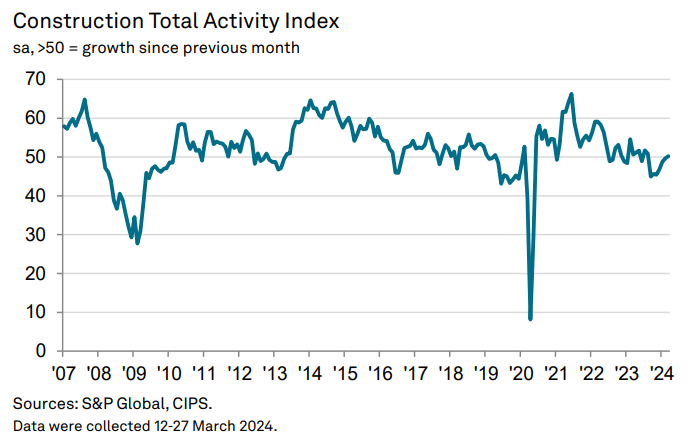
The latest Purchasing Managers’ Index from S&P Global / CIPS UK has revealed that construction output returned to growth in March after six months of decline.
The index rose from 49.7 in February to 50.2 in March, with any reading over 50 indicating output growth.
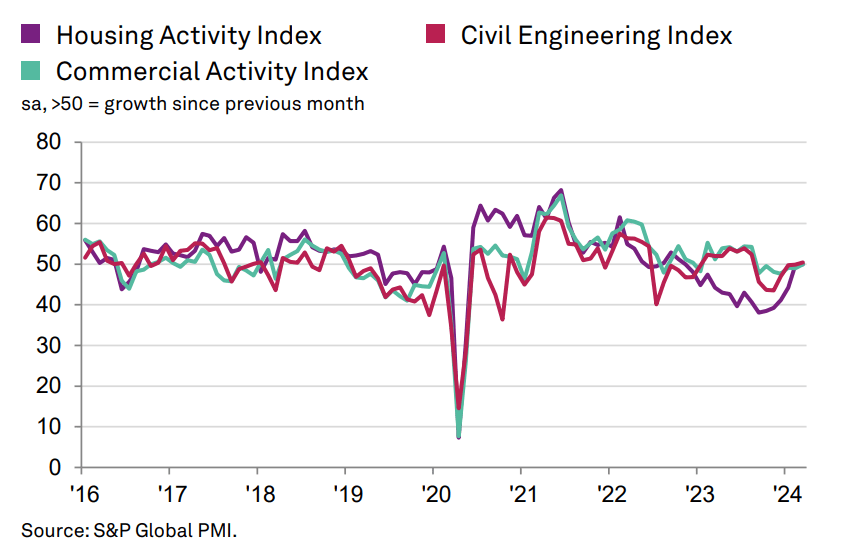
Residential work remained broadly unchanged in March, with this stabilisation representing the best performance for this category since November 2022.
Construction companies remain upbeat about business prospects over the next 12 months, with 49% expecting a rise in output, and only 11% anticipating a decline.
Government publishes guidance on second staircases
The Department for Levelling Up, Housing and Communities (DLUHC) published its guidance for second staircases in tall residential buildings this week.
The guidance recommends for more than one common staircase in apartment buildings 18 metres or above in height, and sets out further parameters for second staircases to be introduced.
However, the update has met with some resistance, with Home Builders Federation Executive Director Steve Turner fearing that the varying interpretations of the recommendation could lead to sites being “impossible to sign off as a design”.
“Designers, builders and contractors fear that there is still too much room for varying interpretation of the guidance document from the different authorities who are involved in approving schemes which will continue to cause delay and frustration to the delivery of much needed new homes,” Turner said, as reported by Housing Today.
 Housing View