
Planning officers voice frustration at last-minute move
Housing Secretary Angela Rayner has called in a housing development in Kent, taking the decision out of the hands of Swale Borough Council.
The 8,400-home scheme was recommended for refusal on the basis of the “urbanising impact”, which they said was “harmful to the intrinsic amenity value of the countryside”.
The intervention by Rayner means that there will now be a public inquiry into the proposals, followed by a report to ministers to determine the case.
The council has promised to “robustly” defend its opposition, saying: “We understand the importance of these two applications but would appreciate being informed of the Secretary of State’s decision before less than three hours until the planning committee meeting so we can adequately prepare our response.”
Meanwhile, Housing Minister Matthew Pennycook has announced that the Office for Place will close, and the National Design Guide and National Model Design Code will be updated early next year.
In a Written Ministerial Statement, Pennycook said that “exemplary development” should be “the norm, not the exception”, and that delivering 1.5 million new homes over the next five years “cannot mean units at any cost”.
The Office for Place was established by the previous government, with a focus on achieving beauty in housebuilding.
In addition, a joint update from the Ministry of Housing, Communities and Local Government (MHCLG) and the Department for Environment, Food and Rural Affairs (DEFRA) has announced that seven councils will receive a share of the £47m funding announced in the Budget to unblock developments currently on hold due to nutrient neutrality rules.
A full list of the councils receiving the funds can be found in Housebuilder.
New work drives construction output growth
The Office for National Statistics has published its latest construction data, revealing that output grew by 0.8% in the third quarter of the year, driven mainly by a 2% increase in new work.
However, new orders were down by -22% on the previous quarter.
Meanwhile, latest figures from payroll provider Hudson Contract has shown average labour rates increasing by 1.9% in October, reaching £1,044 per week.
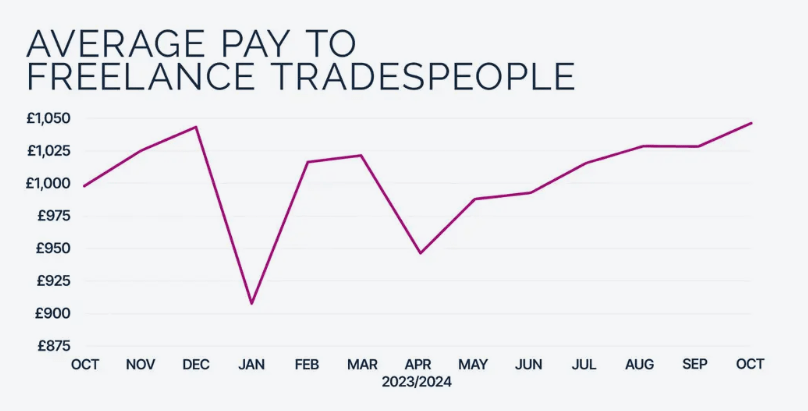
London saw the strongest monthly growth, followed by Wales and the East Midlands. The West Midlands experienced the lowest growth, at 0.1%.

Managing Director Ian Anfield said: “Alongside these rate increases, we are also seeing increases in the number of payments made to operatives by some of our clients.
“However, it’s a mixed bag for the construction industry. Everyone was waiting for the election. Then it came and went. Everyone was waiting for the budget. Then it came and went. Now, everyone is waiting for the promises of planning reform and infrastructure investment to come to fruition at the same time as waiting for legislation that was mentioned in the budget to bite.”
Private sector registrations up 58% in Q3
Latest figures from the NHBC has revealed “cautious optimism”, with private new home registrations in the third quarter of 2024 increasing by 58% when compared to the same period last year.
Almost 20,000 new homes were registered in Q3 2024, with rental and affordable homes also enjoying an increase of 12% to 8,845 units.

Total registrations in the quarter rose by 40% compared to Q3 2023, with ten out of twelve UK regions registering increases.
Meanwhile, new home completions dropped by -9% to 27,868, with private sector completions falling by -12%.
Steve Wood, NHBC’s ceo, said: “Our latest quarter’s figures show that new home registrations are holding steady with some signs of increased activity on site and an emerging mood of cautious optimism amongst housebuilders.
“A further uplift in registrations is needed to move us towards the government’s 1.5 million new homes target, with this dependent on continued easing of interest rates and a rise in confidence amongst consumers and investors.”
The latest UK Residential Market Survey from the Royal Institution of Chartered Surveyors (RICS) also revealed optimism for the future, with an aggregate of 9% of respondents reporting an increase in sales volumes during October.
New buyer enquiries remained stable, with a net score of 12% only marginally less than the 13% recorded previously.
Forterra plans price increases as Gleeson experiences “lack of conviction”
Brick and block manufacturer Forterra has announced that it plans to pass on Employers’ National Insurance increases in the New Year.
In a trading statement the firm said: “In response to these expected increases in our cost base we have announced selling price increases for 2025 and we are currently in discussions with our customers.
“Our ability to deliver these increases will be influenced by both market conditions and the pricing strategies adopted by our competitors.”
Meanwhile Gleeson Homes warned of a “lack of conviction” in the housing market, although net reservation rates did improve between July and November.
The developer added that it was continuing to experience margin pressure as a result of higher build costs, increased sales incentives and “limited relief from increasing selling prices.”
 Housing View