
House of Lords committee concludes inquiry
The House of Lords built environment committee has concluded its inquiry into the Government’s grey belt policy, concluding that it will be unlikely to make any significant difference to the number of new homes that can be built.
The grey belt policy, set out in the National Planning Policy Framework, seeks to unlock lower quality green belt land for development; but, according to the Lords, the policy clashes with other planning reforms.
The combined effect of the final NPPF and other recent planning policy developments is likely to mean that the impact is, at best, marginal.
Rather than making it easier to develop within the Green Belt, and thereby significantly increasing the opportunities for this to take place, the most likely effect of the finalised grey belt policy, if any, will be to nudge councils and developers towards using the existing recognised processes to allow slightly more development in the Green Belt. We believe it more likely that wider policy changes relating to the Green Belt will render the new grey belt policy largely redundant.
House of Lords Built Environment Committee
Lord Moylan, chair of the built environment committee, said: “Last autumn our committee launched this inquiry into ‘grey belt land’ because the committee believed that this new category could make a positive contribution to meeting housing targets.
“The government’s policy been implemented in a somewhat rushed and incoherent manner. The committee does not believe that it is likely to have any significant or lasting impact on planning decision-making or helping the government achieve its target of building 1.5 million new homes by the end of this parliament.”
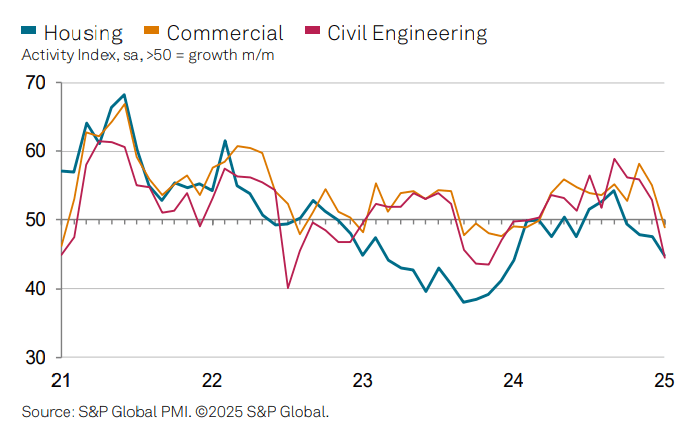
Meanwhile, the S&P Global UK Construction Purchasing Managers’ Index reported a reduction in construction output in January, after ten successive months of growth.
At 48.1, down significantly from 53.3 in December, the index falls below the 50.0 no-change threshold for the first time since February 2024.
Construction firms cited delayed decision-making by clients and general economic uncertainty as the driving factors. Housebuilding decreased for the fourth successive month, down to 44.9.
House prices hit new record high
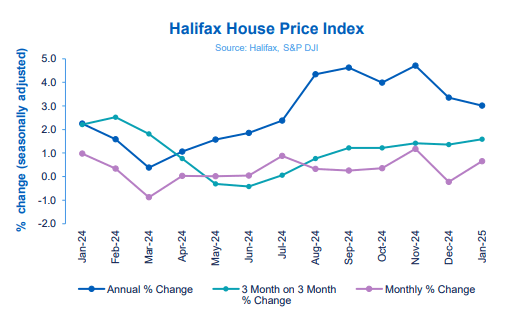
This week saw Halifax publish its house price index for January, reporting a monthly increase of 0.7% in property values, following a dip of -0.2% in December.
The average UK property value has grown by 3.0% over the year (Dec: 3.4%) to £299,138 – a new record high.
Northern Ireland continues to have the strongest annual property price growth in the UK, at 5.9%. Prices in Wales were up by 3.6%, with Scotland experiencing property value growth of 2.4% over the year.
The North East has overtaken the North West as the region with the strongest annual growth in England, up 5.2% on the previous year.
The average house price in London remains the highest in the UK, at £548,288 – up 2.8% compared to last year.
Miller completes St Modwen acquisition
Miller Homes has completed its purchase of St Modwen, after the Competition and Markets Authority gave it the green light.
This means that Edinburgh-based Miller Homes has acquired 19 live sites totalling 3,500 plots, along with five strategic sites, in a deal thought to be worth £215m.
Miller will continue to operate the brand under the St Modwen name, as it continues with its medium-term plan to build 6,000 homes a year.
Meanwhile, Crest Nicholson has recognised a “very tough and disappointing year for the business”, with the housebuilder suffering a £144m loss during its 2024 financial year (FY23: £23.1m profit).
The firm’s total fire remediation provision at its 2024 year end was £249.3m.
CEO Martyn Clark said Crest had been working with “renewed vigour” on operational issues, “revitalising our sales process, improving governance, upgrading management information to allow for better decision making, and enhancing operational rigour and cost control”.
In case you missed it…
Six areas in England are set to elect mayors for the first time, under the next stage of the Government’s devolution plans.
Cumbria, Cheshire & Warrington, Norfolk & Suffolk, Greater Essex, Sussex & Brighton and Hampshire & Solent have been confirmed to join the government’s Devolution Priority Programme, with mayors in these areas to be elected by May 2026.
These areas will be given “sweeping powers,” the Ministry of Housing, Communities and Local Government said, including over housing and transport.
–
The Home Builders Federation has reported that water efficient new build homes can save home buyers £126 per year, reducing the country’s water usage by 3,360 Olympic-sized swimming pools.
New homes use around 40 fewer litres per day compared to older properties, HBF’s research shows.
–
Research from TerraQuest has found that more than 75% of planning applications have claimed exemption from biodiversity net gain requirements, since the policy came into effect last year.
The rules – which set the principle that all developments must achieve a 10% net positive impact on biodiversity – came into effect in the spring of 2024, but are not consistently being followed.
 Housing View