
CPA calls on Chancellor to rescue the housebuilding sector
The Construction Products Association (CPA) has called on Chancellor Rachel Reeves to deliver an emergency stimulus to a struggling housebuilding sector in the upcoming Autumn Budget.
In a letter sent to Reeves this week, the CPA said that there was “no chance” that the Government would meet its 1.5 million homes target without action to restore buyer confidence and unlock barriers to delivery.
Our industry has a responsibility to flag the likelihood of worsening job losses, skills shortages and manufacturing capacity unless this government acts to stimulate growth in this essential sector. This is not scaremongering but rather an honest reflection of what is happening on the ground.
Adam Turk, Chair, Construction Products Association
The CPA is now forecasting that housebuilding will not return to pre-pandemic levels until 2029/30.
Professor Noble Francis, CPA economics director, said: “Construction has already lost more than 11,000 construction firms since the start of 2023, and given the current low levels of house building and home improvement, we expect construction insolvencies to accelerate in 2026.
“A new positive, time-limited stimulus for house building demand is urgently needed from the government – particularly for first-time buyers – before insolvencies further damage skills and capacity throughout the construction supply chain, including architects, builders’ merchants and product manufacturers, as well as house builders and specialist contractors.”
Meanwhile, the Chartered Institute of Housing (CIH) has published its 2025 UK Housing Review Autumn Briefing Paper, which has warned that the Government is set to miss its housing target by around 25%, with around 1.1 million completions likely by the end of the Parliament.
The review also highlights concerns over the financial health of council housing. Many local authorities are forecasting deficits in their Housing Revenue Accounts, forcing them to scale back maintenance and new-build projects.
Construction firms in ‘critical’ distress rises
Latest figures from Begbies Traynor’s Red Flag Alert, which monitors the health of UK companies, has found that the number of construction companies in ‘critical’ distress has jumped by 70% in the third quarter of 2025 when compared to the same period last year.
The number of firms experiencing ‘significant’ distress also rose 14.6% in the year to 103,551.
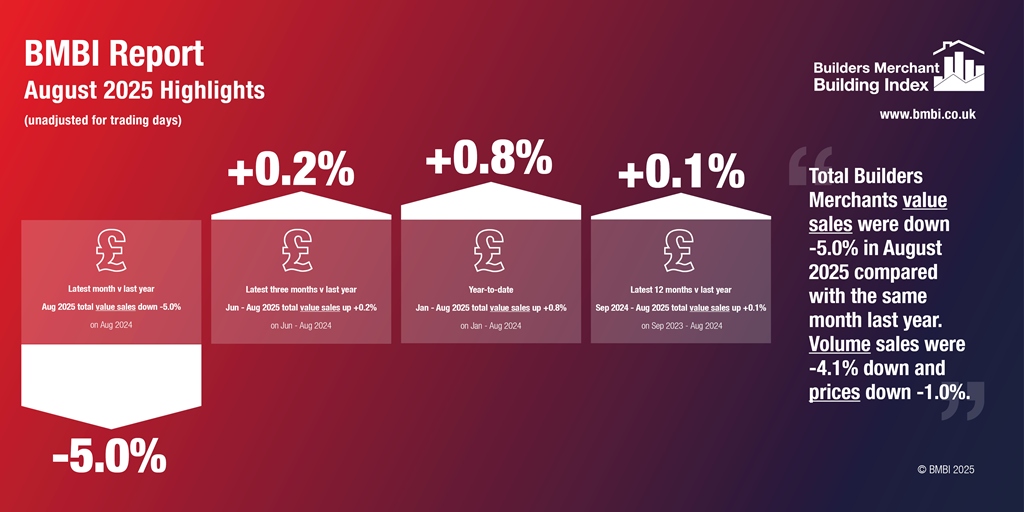
Meanwhile, the latest Builders Merchant Building Index has shown that builders merchants’ total sales fell by -5% in August 2025 when compared to the same month last year.
Year-on-year volumes decreased by -4.1% over the same period.
Annual house price growth improves in October
Latest figures from Nationwide have revealed that the average UK property value rose by 0.3% in October to £272,226.
There was also a slight increase in annual house price growth to 2.4% (Sept: 2.2%).

Robert Gardner, Chief Economist at Nationwide, said: “Looking forward, housing affordability is likely to improve modestly if income growth continues to outpace house price growth as we expect. Borrowing costs are also likely to moderate a little further if Bank Rate is lowered again in the coming quarters.”
Government plans easing of environmental permits
The UK government has announced reforms that will remove the need for full environmental permits for certain low-risk pre-construction activities in England. The changes will apply to works such as site investigations, waste material storage and drainage operations.
Ministers say the move is intended to cut delays at the start of building projects and help speed up the delivery of new homes and infrastructure.
Under the new approach, the Environment Agency will have greater discretion to decide which activities qualify for exemption, provided they meet clear environmental safeguards.
Officials estimate that the reforms could reduce waiting times by up to 16 weeks for some developments and save small businesses several hundred pounds in permit fees.
 Housing View