
Sector bemoans lack of industry support
The housing sector has given a lukewarm reaction to Rachel Reeves’ Spring Statement this week, with the Home Builders Federation (HBF) describing it as a “missed opportunity”.
Neil Jefferson, Chief Executive of the HBF, said: “Whilst the government has made encouraging progress on planning policy, ministers need to acknowledge now the worsening viability and affordability constraints on the home building sector. This is quite clearly reflected in today’s OBR projection for home building that shows a huge undershoot on the government’s 1.5 million homes target.
“The Spring Statement is a missed opportunity to address this. Home builders are struggling to meet the ambitious targets of housing delivery alongside the backdrop of worsening viability conditions for housing developments as a result of new taxes, levies and policy costs.”
Elsewhere – as reported in The Construction Index – Rico Wojtulewicz (Director of Policy and Market Insight at the National Federation of Builders) said: “To help ramp up housebuilding and construction capacity, we hope the Autumn budget will be used to increase market confidence through a new Help to Buy scheme, to pump-prime key infrastructure projects, to ensure unspent planning contributions are spent or returned, to let Homes England off the leash, and to find ways to help SME housebuilders and regional contractors in both procurement and planning.”
OBR forecasts drop in housing delivery
The Office for Budget Responsibility (OBR) has forecast that housing delivery is set to fall to a low of 220,000 homes in 2026/27.
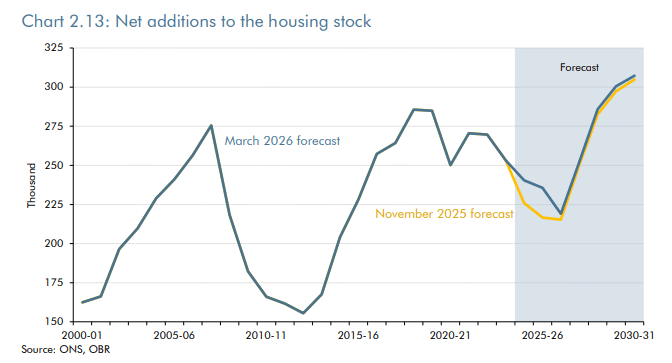
Publishing its economic and fiscal outlook following Reeves’ Statement, the OBR also stated that net additions to the UK housing stock were rising to “just over” 305,000 homes a year into the next decade, “reflecting the impact of planning reforms”.
In line with our March 2025 judgement, the reforms’ impact on net additions has yet to meaningfully materialise in outturn.
The forecast casts further doubt on the ability of government to hit its 1.5 million homes target during this Parliament, as noted by the Construction Products Association in their response to the Spring Statement.
[The OBR] still forecasts only 1.3 million net additional dwellings in the UK over the 5-year Parliament. The government’s 1.5 million target is for England only over 5 years, and the OBR forecast is equivalent to 1.1 million net additional dwellings in England.
So the OBR forecasts that the government will miss its house building target by 400,000 homes or 26%.
Construction Products Association
Meanwhile, the latest Construction Purchasing Managers’ Index from S&P Global saw construction activity fall for the fourteenth successive month, registering 44.5 in February – down from 46.4 in January.
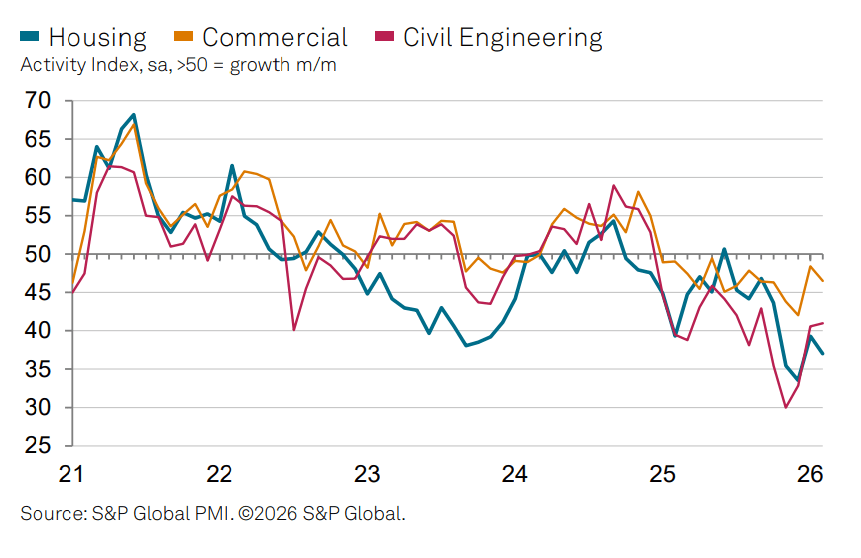
Residential building remained the weakest-performing segment in February, falling to 37.0, with an accelerated rate of decline since January.
However, business activity expectations improved to the highest since December 2024, with 42% of the survey panel forecasting a rise in output levels during the year ahead.
Housing market maintains early momentum
The Halifax has revealed a 0.3% increase in house prices in February, following an 0.8% increase in January, bringing the average property price to £301,151.
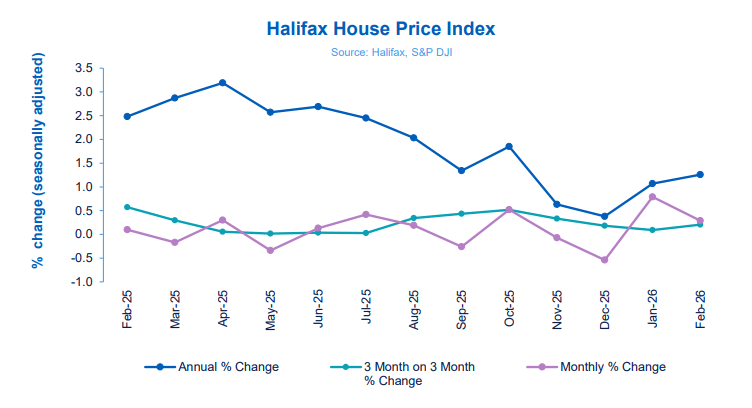
The annual growth of 1.3% is the strongest in four months, with Northern Ireland and Scotland continuing to post the highest annual percentage growth at 6.3% and 4.7% respectively.
Wales saw a more modest increase of 2.4%. In England, stronger price growth remained concentrated in northern regions, with the North East experiencing a 3.5% increase in property values.
Meanwhile, Nationwide reported a similar monthly house price increase of 0.3%, with an annual increase of 1.0%.
The average house price now stands at £273,176 in February.
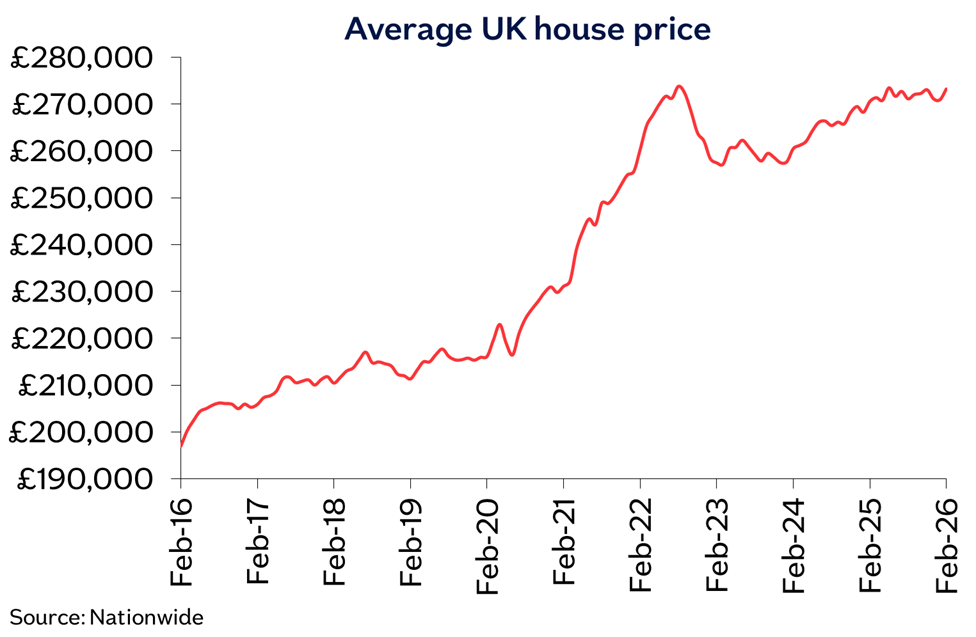
Robert Gardner, Nationwide’s Chief Economist, said: “Housing market activity is likely to recover in the coming quarters, especially if the improving affordability trend seen last year is maintained as expected.”
Women in Construction Week celebrated
The industry celebrated Women in Construction Week and International Women’s Day this week.
Women still only represent around 15% of the construction workforce, according to Office for National Statistics data.
The HBF has opened the eighth cohort of its Women into Home Building programme, with applications closing on 22 March.
Local authorities sitting on £9bn of developer contributions
Local authorities in England and Wales are holding more than £9bn of developer contributions made via the Community Infrastructure Levy and Section 106 Agreements, according to the HBF.
The contributions are intended to fund essential local infrastructure such as schools, public transport and affordable housing.
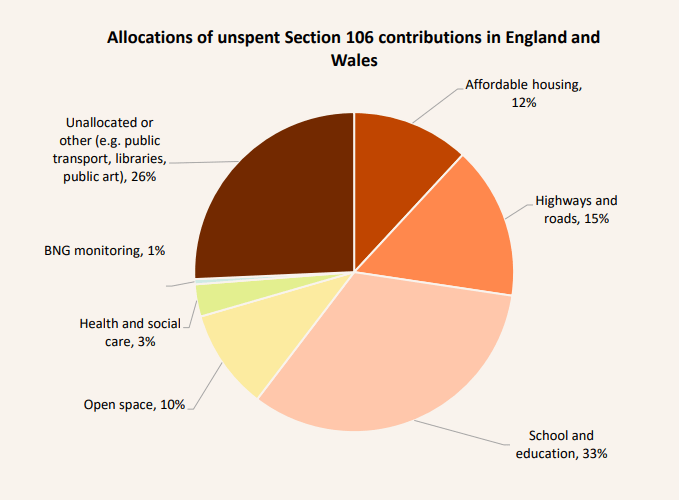
The findings from a Freedom of Information (FOI) survey, which received responses from 243 local authorities in England and Wales, show that, of the £9 billion estimated to be unspent, around £3 billion has been held for more than five years, despite many agreements requiring funds to be used within that timeframe.
Housing association investment into new homes falls
The latest annual value for money report from the Regulator of Social Housing (RSH) has found that housing association investment into existing homes has reached a record level, increasing 15% to £3.8bn.
However, investment into new homes fell by -4% to £11bn.
Meanwhile, off-site providers of biodiversity units have written to government ministers to request them not to introduce further net gain exemptions.
The Biodiversity Net Gain policy was introduced in 2024 and requires to deliver a minimum 10% increase in biodiversity on their sites or find equivalent alternatives.
However, ministers have since introduced exemptions for smaller builders.
Developer and supply chain updates
Barratt Redrow has appointed Dean Banks as its next group Chief Executive, succeeding David Thomas who will retire later this year after 11 years in the role. Banks, currently Chief Executive of Ventia Pty, is expected to join in the final quarter of the year as the company enters its next phase of growth.
Thomas will remain in post until Banks arrives and will stay with the business until March 2027 to ensure a smooth transition. Banks brings more than 15 years’ senior executive experience in listed global businesses, including roles at Balfour Beatty and De La Rue.
–
Greg Fitzgerald has announced his retirement from Vistry Group, stepping down as chair at the AGM on May 13 while remaining Chief Executive for up to 12 months as the company searches for a successor. The board said the dual CEO-Chair role will be split on his departure as part of a planned succession process.
Vistry reported adjusted pre-tax profit of £268.8m for 2025, up 2% and in line with guidance, although revenue fell -4% to £4,155.3m as completions dropped -9% to 15,658 homes. The partnerships-focused housebuilder cited ongoing private market weakness and pre-Budget uncertainty but said trading met expectations.
–
Taylor Wimpey increased revenue by 13% to £3,844.6m in 2025 as UK completions rose 6% to 10,614 homes, with average selling prices climbing to £374,000. Sales rates were broadly stable year on year, although the private rate excluding bulk deals edged down to 0.65 from 0.67.
Pre-tax profit fell -54.3% to £146.5m after £243.8m of exceptional costs, largely linked to increased cladding remediation provisions and an £18m charge tied to the company’s voluntary agreement with the Competition and Markets Authority. Adjusted operating profit rose slightly to £420.6m, while margins slipped to 10.9% from 12.2%.
–
Profit at brickmaker Ibstock fell to just £1m last year as the firm booked more than £19m in exceptional charges, the firm said in annual results announced this week.
–
Future Homes Hub has launched a new initiative to help housebuilders prepare for the forthcoming Future Homes Standard, with a focus on supporting SME developers. The campaign, called Future Homes Standard Essentials, sets out seven practical steps based on industry experience to help firms start preparing for compliance.
The guidance covers areas including grid connections, heating design and procurement, and customer engagement, reflecting the shift away from fossil-fuel boilers towards low-carbon systems such as heat pumps. The Hub said the initiative aims to reduce delivery risks as the sector prepares for the new standard, which is expected to be published in the first quarter of the year.
 Housing View