HBF report reveals ongoing challenges
Almost three-quarters of small and medium-sized developers are being hampered in delivering new sites by market conditions, according to a report by the Home Builders Federation (HBF).
Findings from the HBF’s SME Sentiment Survey show that the sector remains cautious about the outlook for the housing market, with 41% expecting to increase the number of homes they start building in the next three months.
In addition, almost a third (28%) expect housing starts to decline in the next three months, with 18% braced for a significant reduction.
Small and medium home builders play a vital role in a healthy housing market and in increasing housing supply.
However, they are also the ones most impacted by the ongoing market conditions, lack of demand, and rising taxes and policy costs.
While planning changes have been positive much more is needed to address the concerns of SMEs to enable them to play their part in delivering more homes.
Neil Jefferson, Chief Executive, Home Builders Federation
Future Homes Standard launched
This week the government launched the long-awaited Future Homes Standard, with the majority of new homes to be fitted with solar panels as standard.
The Department for Energy Security and Net Zero and the Ministry of Housing, Communities and Local Government said they had “created a new functional requirement for the provision of renewable electricity generation”.
Housebuilders will be expected to build to Future Homes Standard requirements by 2028, following a one-year lead-in period and a one-year transition period.
Government announces plan to abolish retentions
The government has unveiled plans to scrap retentions in construction, under a series of measures announced this week.
In addition, the Small Business Commissioner will be given powers to investigate poor payment practices, adjudicate payment disputes, and fine offenders.
Business secretary Peter Kyle said: “Far too many businesses are forced to shut down because they have not been paid – that is simply unacceptable.
“We are unveiling the strongest, most robust changes to payment laws in over a generation – laws that will transform the fortunes of small businesses for years to come and make their day to day lives much easier.”
Building reports a mixed reaction from industry leaders.
London planning rules scrapped
Housing Secretary Steve Reed and Mayor Sadiq Khan have agreed a package of emergency, time-limited measures in a bid to kickstart housebuilding in London.
Schemes delivering at least 20% affordable housing will be pushed through an accelerated planning route, with developers also getting temporary relief from Community Infrastructure Levy charges where sites meet certain criteria.
Khan also has the power to take over and decide applications of 50 or more homes where boroughs intend to refuse.
Housing starts in the capital have fallen dramatically to 4,522 in 2024/25, down from 26,386 two years earlier.
House prices increase in January
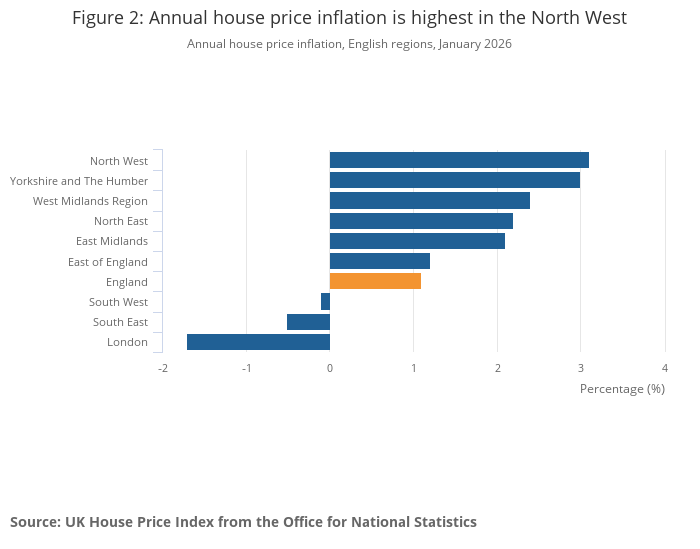
The Office for National Statistics (ONS) has published its latest house price index for January, revealing a 1.3% annual rise in property value.
The average house price is now £290,000 in England, £210,000 in Wales and £188,000 in Scotland.
Housebuilding is ‘AI-proof’, says report
A report from the HBF and Pluto Finance has found that artificial intelligence (AI) is set to increase the need for skilled labour across home building and its supply chain, rather than replace jobs.
The report – Artificial Intelligence and skills in the home building industry – shows that just 6% of industry businesses expect AI adoption to reduce company headcount in the future, compared to 11% of businesses in other industries.
While AI is expected to play an increasingly important role in improving construction processes, design, planning and productivity, AI cannot lay bricks, install roof trusses or plaster walls.
Nine in ten early talent respondents said that the job security offered by home building was an important factor in choosing to join the industry, while 70% said protection from rising automation was a motivation for doing so.
HBF / Pluto Finance
Developer and supply chain updates
Bellway expects to exceed its previous full-year completions guidance, forecasting output above the 9,300–9,500 range for the year to July 2026, with average selling prices also now seen higher at around £325,000. The upgrade follows a 2.7% rise in first-half completions to 4,702 homes and a 6.3% increase in revenue to £1,520.1m.
Profit performance was broadly stable, with statutory pre-tax profit down -0.6% to £139.9m and underlying pre-tax profit up 0.5% to £150.9m, while margins eased to 10.5%. Bellway warned that inflation risks linked to the Middle East conflict could impact costs despite the improved outlook for volumes and pricing.
–
Crest Nicholson reported a “sustainable improvement” in sales since mid-January, with its open market sales rate rising to 0.64 in the ten weeks to March 20, up from 0.61 for FY 2025. The update follows a period of weak trading conditions in the second half of last year, with full-year guidance unchanged.
The housebuilder said it has made strong progress repositioning the business towards the mid-premium segment under its Project Elevate strategy. Crest added that it will report its half-year results for the six months to April 30 on June 11.
–
Miller Homes reported a record 2025, with completions rising 29% to 4,931 homes following the integration of St Modwen Homes, helping drive turnover up 34% to £1,425m. Pre-tax profit surged 74.5% to £124.1m, while adjusted operating profit increased 40% to £219m and margins edged up to 15.4%.
The housebuilder said the performance reflects successful integration of the acquisition, continued land investment and expansion of its multi-tenure model. Average selling prices rose 4% to £295,500 as the business progresses towards its target of delivering 7,000 homes annually.
 Housing View