
First annual report reveals labour requirement
The first ever Annual Skills Report 2026 from Skills England has revealed that the UK construction industry needs to recruit a million more workers over the next ten years to meet demand.
The report states that by 2035 the sector will need 493,000 additional workers across the top construction job categories; a 26% increase on current levels.
In addition, the industry will need to replace the 595,000 workers expected to leave due to retirement, career change and other factors.
Skills England research also found that the construction industry will find it more difficult to keep hold of skilled individuals as they become tempted by other sectors.
House prices dip in May
Two key house price indices published this week have revealed a slight fall in house prices during May.
Nationwide reported a -0.6% dip, with the average property valued at £278,024 (Apr: £278,880). UK annual house price growth also slowed to 1.7%, from 3.0% in April.
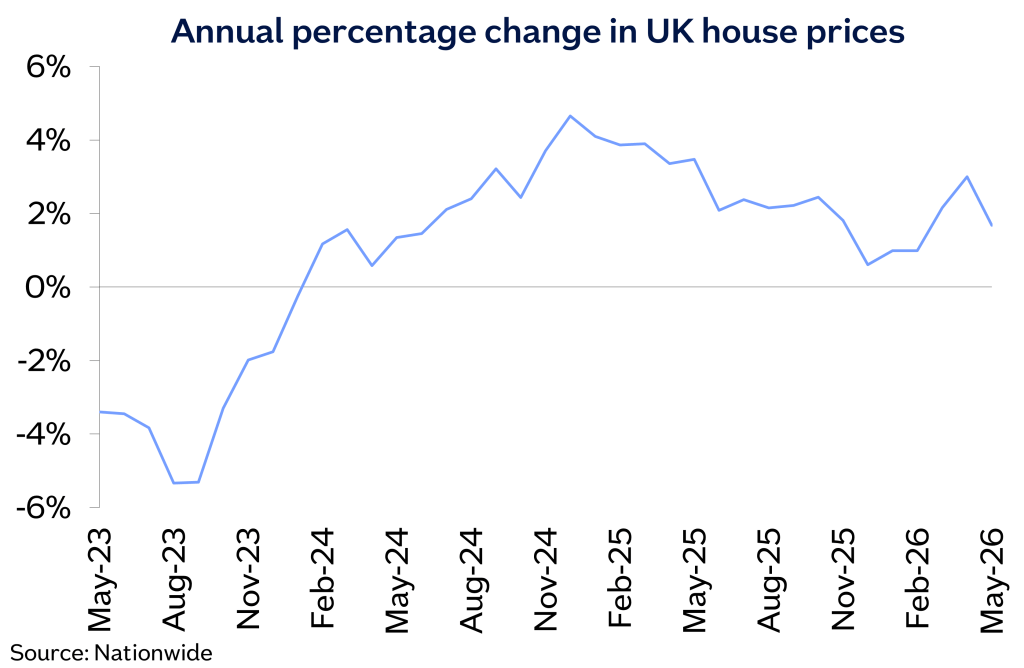
Robert Gardner, Nationwide’s Chief Economist, said: “Given the uncertainty caused by developments in the Middle East and the subsequent rise in energy prices and market interest rates, some loss of momentum was to be expected.”
He went on to say that “consumer conflict has weakened noticeably since the start of the conflict”.
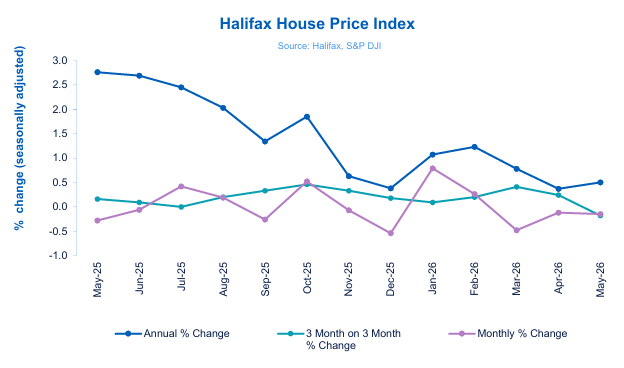
Meanwhile, Halifax reported a -0.1% reduction in house prices in may, following a similar -0.1% fall in April.
Annual growth increased slightly, from 0.4% in April to 0.5% in May, bringing the average property price to £298,806.
Northern Ireland continues to lead UK annual house price growth, with prices up 7.8% over the past year. Scotland recorded annual growth of 3.8%, with Wales seeing property price growth beginning to slow, at 0.1% over the year.
House price growth in England continues to remain concentrated in northern regions, with the North East enjoying price rises of 3.1% over the year.
However, house prices in the South East led declines in southern markets, with prices down -2.1% year-on-year.
UK construction output falls at fastest pace for six years
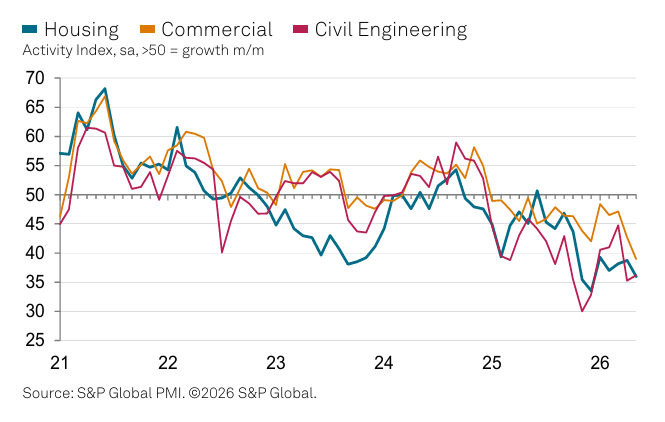
Economic uncertainty and rising inflation in the wake of the conflict in the Middle East has driven a sharp decline in housing activity, according to the S&P Global Purchasing Managers Index.
Higher energy costs combined with shrinking order books led to an overall index of 38.2 in May, down from 39.7 in April; below the neutral 50.0 threshold for the seventeenth month running.
Residential activity was the weakest performing segment, registering 36.0.
Tim Moore, Economics Director at S&P Global Market Intelligence, said: “Concerns about a prolonged decline in construction order books, alongside unfavourable near-term UK economic prospects, weighed on business optimism in May.
“This index has fallen sharply since the start of 2026, and confidence levels are now almost as low as those seen ahead of last autumn’s Budget.”
Planning committee reforms delayed by one month
The introduction of the national scheme of delegation by the government has been delayed by a month, according to the Ministry of Housing, Communities and Local Government (MHCLG).
MHCLG stated that it had “pushed back” the implementation date of the changes, which would see certain applications passing to officers and other committees, “to allow local authorities further time to make the necessary arrangements”.
Developer and supply chain updates
The Hill Group and Homes England, supported by the National Housing Bank, have acquired the 700-acre Cambridge East site, paving the way for a major mixed-use development comprising more than 10,000 homes, at least 3 million sq ft of commercial space and around 9,000 jobs. The scheme includes Cambridge City Airport and will be delivered through a partnership between Hill and the Cambridge Growth Company, a subsidiary of Homes England.
Plans for the site include schools, healthcare facilities, extensive green space and supporting infrastructure, alongside the potential creation of a regional construction training hub. The development is also expected to benefit from the proposed Cambridge East station, which would enhance transport links across Cambridge, London and the wider Oxford-Cambridge Growth Corridor, subject to planning approval and funding.
–
The government is pressing ahead with the creation of the Greater Cambridge Development Corporation despite significant opposition revealed through a public consultation. Of the 773 respondents, 68% of individuals and 48% of local government organisations were opposed or mostly opposed to the plans, although only 8% of private sector organisations expressed similar concerns.
The new joint national and local body will be tasked with unlocking housing and economic growth across Greater Cambridge, including assembling land, investing in strategic sites and bringing forward stalled developments. The move forms part of the government’s wider growth agenda, backed by £800m of investment for Cambridge and Oxford to support new homes, transport infrastructure, green spaces and improved connectivity.
–
Housing associations have increased their development spending forecasts for the fourth consecutive quarter, with providers now expecting to invest £10.7bn over the 12 months to March 31, according to the Regulator of Social Housing. The figure is up slightly from the £10.6bn forecast reported in the previous quarter.
The increase comes as a growing number of providers revise their development grant assumptions to reflect the government’s £39bn Social and Affordable Homes Programme, signalling continued confidence in future affordable housing delivery despite wider sector pressures.
–
Builders’ merchants recorded a -3.2% fall in sales in the first quarter of the year compared with the same period in 2025, according to new figures from the Builders Merchants Federation (BMF). Despite weaker demand, average prices increased by 5.7%, reflecting ongoing inflationary pressures across the sector.
The BMF said declining construction activity, particularly in private housing, combined with wet weather, a sluggish housing market and the impact of the Iran conflict on energy costs, had weighed on trading. The organisation warned that without government intervention, it is difficult to envisage a significant market recovery over the coming year.
 Housing View